Tuesday, January 19, 2010

Bread

I had never seen a flock of robins: I have only seen only one or two at a time, usually in the spring, bouncing across the lawn, cocking their heads as if listening for subterranean clues. But there they were, twenty or more, kicking up the dry leaves in the side yard.

My reaction, on that unusually frostbitten Carolina morning, was to feed them.

I sprinted out the side door, still in my nightgown and robe, and tossed a bowlful of crumbled, stale bread onto the asphalt drive. From the warmth of the dining room, I watched. No takers. They all resumed the tossing of leaf litter, each in his or her own square yard, ignoring the food that lay two feet away.

Hmm. I logged on and googled “robin”. There I found that the birds flock together in winter and eat worms, insects and berries. No seeds. No bread crumbs either, evidently. They did not recognize my offering as food.

It got me to wondering: would a robin starve to death surrounded by food, just because it did not recognize it as such? And then God whispered. People starve to death spiritually all the time, with a Bible just a few feet away. With a Christian just a few feet away.

Outside, a squirrel had discovered the bread. Rapid-fire, she buzzed through several larger pieces before springing up, alert, to survey for competition. Finding none, she grabbed another piece, held it in her mouth, and scampered to the base of a tree where she buried it beneath the leaves. After several trips, she caught the attention of a robin.

The robin investigated. It tested a crumb. And tasted again.

And God convicted. You have the bread of life. Are you publically partaking? Do your actions show that it is good? Are you taking the treasure out into the field? Or will you let the hungry die from lack of knowledge?

I looked for the robins this morning, but they were gone.

Monday, January 11, 2010

Forgiving One’s Self

God has my attention.

In the past two days, the same subject has arisen four separate times. The first was in a Sunday School lesson. The next, within hours, was in my facebook inbox. The third time was in a book I was reading. And the fourth time? During a detox massage. Pretty unrelated occurrences, wouldn’t you think? That’s why He has my attention.

The subject? Forgiving one’s self.

Oh, great. Time to open wounds. Yay.

Not so fast, my friend! You may be as surprised as I was to find out where this goes.

One path I take when exploring a subject for writing is to find out what the Bible says about it. Guess what? The Bible doesn’t say anything (that I can find) about forgiving yourself. Don’t you find that odd? How could that be? Certainly there are pages and chapters and entire books devoted to the subject in the local bookstore!

The Bible does speak repeatedly about forgiveness. It is something that God offers to us. We get the first taste of it when we acknowledge our sin, repent, and accept Christ as Lord and Savior. Our sins are forgiven. Read the beautiful imagery of Psalm 103:12 (NASB): “As far as the east is from the west, So far has He removed our transgressions from us.”

Therein, I believe, lies the answer.

God’s forgiveness is completely, wholly sufficient. It is permanent. Therefore, if I say that I cannot forgive myself, I am implying that God’s forgiveness is not enough. I must realize that it is not necessary, or even scriptural, for me to forgive myself. Did I take it to God? Did I ask Him to forgive me? Then, God has taken care of it. Period.

Our real issue, I think, is in letting go.

Would you believe that one day before the “forgiving self” topic came up, God gave me a script to write? It was about letting go. Fancy that. Why does it still surprise me when God sets me up? (smile)

In that script, one person stands holding the string of a balloon which represents something they claim to be giving to God. The problem is, they will not release the string.

Are you still holding on? Why?

It all boils down to a faith issue. Do you believe God has forgiven you?

Let it go. Don’t hold onto the string. Release the grip. God places blessings in an OPEN hand.

Friday, January 8, 2010

THIS IS WAR!

Perhaps it was the discovery that there are NFL players who weigh about the same as I do (and I am not talking punters or kickers). Perhaps it was the picture someone posted of me, taken when I was unguarded. Maybe it was the realization that someone I thought looked like could be three or four of me was actually only twice my weight. Regardless, I am now aware.

The scale in the bathroom was not kind in its estimation of my weight. Ugly, round numbers glowered at me, laughed at my state of shock. Disbelief gave way to anger.

How? How did I let this happen?

It is not the heaviest I have been, but I never thought I would see 180 again.

And so, my friends, I declare war.

War on weight. War on fat. War on complacency.

I am choosing my strategies and weapons. I am studying the enemy. And I am rallying my troops.

This is my recruitment effort. Would you like to join me?

Here I will be posting my progress. I will share my journey. You can share yours with me and we can keep each other accountable. We can share what is working and what is not. We can encourage and cheer one another on!

Weight War 2010. Healthy again in 2010. Begin again in 2010. Help me choose a battle cry! Post your comments!

Thursday, December 3, 2009

Day Three: Nativity

HISTORY
St. Francis of Assisi is credited with giving us the first nativity scene in the year 1223 AD.

One account tells that he and his fellow monks performed a play that year for the people of a poor Italian village. The play was held in a cave and was intended to be a reminder to the villagers that Jesus was born for them, into a poor family like theirs. Another account paints the picture of St. Francis performing a nativity play himself, using small wooden pieces to represent the characters.

A lasting tradition is that St. Francis asked a man named Giovanni Vellita of the village of Greccio to create a manger scene. St. Francis performed mass in front of this early Nativity scene, which inspired awe and devotion in all who saw it.

The play became hugely popular and the creation of the figures or pastori became an entire genre of folk art.

Nativity scene figures always include Mary and Joseph. Jesus is often added on Christmas Day (or late on Christmas Eve), usually placed in a manger. Some scenes have shepherds, sheep and angels. Wise Men and their camels traditionally wait to arrive until the twelfth day after Christmas, known as Epiphany.

There are two traditions of portraying Mary:

The Western tradition says Mary was virginal and also was not subject to the curse of Eve (a Catholic teaching that her soul was pure when her body received it in her own mother’s womb). Therefore she did not suffer during labor. This is why she is depicted either seated, holding Jesus on her lap, or on her knees in adoration.

The Eastern tradition, on the other hand, emphasizes the reality of the incarnation of Jesus and his human birth: Mary, having just given birth, is pictured lying down.

INSIGHT
Mary lived far from Bethlehem, yet prophecy held that the Messiah would be born there. How did God solve the disparity? He used a Caesar to order a census. He always has a plan, though we might not always see or know it.

SUGGESTION
Display a nativity scene in your home. You could put the Wise Men in a separate room and move them closer, day by day, until Epiphany (January 6). Keep shepherds on a hillside close by, until Jesus is born. Add a little straw to the manger as the time draws near. Read Luke 2:1-19 and Matthew 2:1-11 as you move the characters.

Wednesday, December 2, 2009

Day Two of Twenty-five Days of Christmas

ADVENT

HISTORY
The word “advent” comes from the Latin word adventus meaning "coming". It is celebrated for the four weeks that precede Christmas, one week for every millennium between the Fall of Adam and the Birth of Christ.

Advent was not always associated with the birth of Christ. In the early Church, it was His second coming that was anticipated, not His birth. (Latin adventus is the translation of the Greek word parousia, used in reference to the Second Coming.) Eventually, the Church extended the celebration of Advent to include the coming of Christ through his birth in Bethlehem.

Observing the season of Advent with an advent wreath is one way to keep Christ literally at the center of our attention: the wreath has a white candle in the center, representing Christ. Four other candles, three purple and one pink, are arranged in the greenery of the wreath itself and are lit on each Sunday in Advent. The light grows each week, reflecting the growing anticipation of the birth of Jesus, the Light of the world.

Purple symbolizes repentance and fasting. Purple is also the color of royalty, in anticipation of the coming King.

Pink or rose represents joy and reveals a shift in the season away from repentance and toward celebration. This candle is lit on the fourth Sunday in Advent.

The white candle in the center represents Christ and is lit on Christmas Day.

INSIGHT
Advent is a time of preparation for Christ. But is it really Christmas, the Christian Christmas, for which you are preparing? Are you calm, or stressed? Joyful or jangled? Does your list of things to get done take precedence over sitting with God every morning? What would one of the first century Christians think Christmas was about, judging only from your behavior/schedule/attitude?

SUGGESTION
Consider an advent wreath for your home. It can be as simple as candles in a circle on your dining room table, but be sure to place it where you can see it often. Light one candle on each Sunday beginning the Sunday after Thanksgiving. Why not set it up after Thanksgiving dinner and start a new tradition of beginning the season when your hearts are still full of gratitude to God?

Tuesday, December 1, 2009

Day One's Reading from My New Book!

Christmas Beginnings

HISTORY
We celebrate Christmas as the birthday of Jesus. But the Bible does not record the date of His birth, so how was December 25 chosen?

The answer comes from the historical pattern of the Church of eradicating pagan practices by Christianizing them.

In Northern Europe, the pagans celebrated the winter solstice in late December. The Romans honored their god Saturn and the “birth of the unconquered sun” (dies natalis solis invicti') on December 25. The Church decided instead to celebrate the birth of the Son (who was certainly unconquered!), and incorporated the pagan traditions of Saturnalia, changing their meanings. Thus the celebrations would not be a stumbling block to new converts, who could continue with their long-loved customs, albeit with new meaning.

A nativity celebration first appeared on the Roman Church calendar on December 25, 336 AD.

INSIGHT

As you read through this book, you will find that many of our Christmas customs have their origins in paganism.

Does this mean we should be appalled and decide to not celebrate? I don’t think that’s a good response!

In the heart of the Christian worshipper, the focus of this season is the gift of Jesus Christ and His gift of eternal life. Ancient pagan ways have been given new meaning. We do not celebrate Saturnalia on December 25!

This is the time of year when even many non-Christians pause to think about the meaning of Christmas. If it is our purpose to bring them to Jesus, then we can use even these secular aspects to point them towards Him.

Like Peter the Jew reaching out to Cornelius the Gentile, we the Christians reach out to the lost. We have to meet them where they are.

SUGGESTIONS
Read Acts 10:1- 11:24 to learn about Peter and Cornelius. This “reaching out to the non-Jew” was a major turning point for the Church. Without it, you and I may never have known Christ.

Whom do you know that needs to be pointed towards the Reason for the Season? Pray for that person and ask God for ways to reach out to them.

Thursday, November 12, 2009

Little Blue Beads of Faithfulness


Last year, on a trip to Pittsburgh, I saw a necklace that I just adored. It had blue beads and a silver pendant on which was etched a tree. If you know me, you know that the tree is one of my favorite symbols of God’s faithfulness, as in Jeremiah 17:7-8.

The necklace was in a box with matching earrings. The sale sign said it was a “special purchase”, and, for less than $10, I bought it. I’d been searching for just the right color of blue beads, and here they were!

When I got home, I was disappointed to find that the necklace itself was really more of a choker and was too short for my comfort. Determined to find a way to wear it anyway, I took it apart. The pendant became a slide that fit perfectly on a wire I already owned. The beautiful blue beads went into my crafting box to be used at a later time.

This week, my husband and I were packing shoeboxes for Operation Christmas Child. I chose to pack for a teenage girl, and thought that she would enjoy making her own jewelry, so I went to my crafting box in search of beads to add to the ones I’d purchased. There were my special blue beads. I resisted.

Surely God would not want me to give away those beads. The others I had were replaceable; I could simply go purchase more if I wanted. Those were no longer available, and besides, there weren’t enough to fill the little compartment in the bead box. But God reminded me that I was to give sacrificially. It wasn’t a huge monetary sacrifice, but it was something I was unwilling to part with. God won. The beads went into the girl’s box.

Last night, we took our boxes to the church for collection. Then we went to service.

The worship service was awesome and heart-provoking. We learned about letting go of fear and of God’s faithfulness. We sang of God’s blessing and of His faithfulness.

After service, a friend rushed to find me. She said, “I have something for you.” Daphne reached into her pocket and pulled out a necklace and earrings. She said God spoke to her in service and told her to give them to me, and so she took them off then. She said it was unusual for her to wear that particular necklace, but had felt prompted to that night. Once she was in service, she knew why.

I looked at the offering to me and was dumbstruck. Friends, it was the twin of the necklace I had purchased the year before in a town eight hours away; the very same pendant, the same perfect blue beads that sat in a shoebox a few yards away. The very beads I had been asked to give up were now returned to me! How is that possible?

Is your mouth not just hanging open? Tell me He doesn’t perform little miracles to let us know He is here and He is involved and He wants us to know that He is faithful. Try to tell me He isn’t real! I have evidence in the obedient actions of a faithful friend and in the undeniable form of beautiful blue beads and a silver tree pendant.

Thanks and glory be to God!

Tuesday, October 20, 2009

Foreword to a book I am writing...

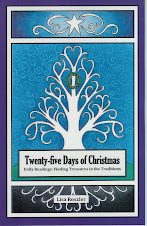
Twenty Five Days of Christmas
A Devotional Book: Finding Treasures in the Traditions of the Season


Do you ever wonder about the meanings behind our traditions?

For me, the drive to discover the genesis of Christmas traditions came after studying “covenant” in the Bible. I was intrigued and delighted to find that many wedding customs are based in covenant language and ceremony: the exchange of vows and rings, the walking of a center aisle, the sharing of food and drink, the bride’s taking the husband’s name, to list just a few.

I began to wonder about our Christmas traditions. Where did they originate? Is there any Biblical basis for them? If not, is it possible to use even the secular aspects of the season to refocus on the Reason? Where is the treasure in the tradition?

Life, to me, is like a glorious treasure hunt. God wraps wonderful little gifts and leads us on the hunt to find them. He has given me a shovel and instructed me to dig. Here, I share with you what I have uncovered. My hope is that you find something of value to share with your family and friends as you celebrate with a renewed passion all things Christ in Christmas.

Tuesday, September 15, 2009

Married or equivalent

Change, I know, is inevitable.

Our language changes. Words get new meanings. Even words that are improperly used become acceptable when Webster’s decides that they have become so commonplace that they are now part of our language and are, therefore, now proper.

That irks me.

For example, take the lovely word “nauseous”. It used to mean “something that makes one nauseated”, as in, “That scent makes me nauseous”. A person would never say he was nauseous, because that meant that he made people feel as if they were going to expel the contents of their stomachs. He would say he was nauseated. But the incorrect “nauseous” surpassed the correct “nauseated” in usage. Now they are considered synonyms.

This kind of word-wiggling has hit home twice this week.

Get this: my daughter reports that her English professor is trying to make the “f-word” more acceptable, saying it shares its root with the word “conflict”. The teacher says it should not be viewed as being offensive. Say what? The teacher then asked for a show of hands of students who had never used the “f-word”. Only two hands went up, including my daughter’s. It reminds me, unnervingly so, of my ethics class when my professor asked the Christians in the room to raise their hands.

(Y’all, I could go off on that one for several pages, but will restrain myself for another day.)

Then came the kicker of the week, in the form of a question on a survey.

I was asked to check one of two choices: married or equivalent, or single or equivalent.

Pardon me? Uh, come again? When did there become an equivalent to marriage?

Little by little, the cultural moth eats away the moral fabric. The f-word becomes commonplace and professors in public universities praise its uncommon flexibility as noun, verb, adjective, phrase… and more! Surveyors decide that marriage can be synonymous with whatever one desires to equate it. Next, other surveyors will hail the wording as a pleasant, forward-thinking solution and it will become the normal survey question.

Forgive me if I’m nauseated.

Thursday, August 27, 2009

Ready?

I awoke in the wee hours of this morning, aware that I had been crying in my sleep, the intense dream still clearly present in my mind.

In the dream, I was puttering around the house, doing the mundane thing of the day, when an angel of the LORD appeared and said, “Are you ready? It is time to go.”

“Go?”

“Yes, your time on the earth is over.”

“But I can’t go yet! I still have so many things I wanted to accomplish! And… and…no one is here with me! I need to tell them all I love them… just one more time, please! One more hour, please, that’s all I ask!”

“Very well. One hour. But you cannot go anywhere and you cannot tell anyone that you are about to die.”

And in the dream, I began to write, to pour out love and hopes and dreams and encouragement and gratitude to the people whom I love and cherish.

When I opened my eyes, my heart was pounding. What if it were true? What if this is my last day on this planet? Was I ready? And since the answer to that last question was an unequivocal “no”, what was I going to do about it?

Today, I am writing notes to my loved ones. Some of those notes will be in the mailbox this afternoon. Some people I will email. One of my children lives close enough to receive fresh, homemade cookies. My husband will be the recipient of some undivided attention.

Today, I will take the love that God has given to me and I will pour a measure of that love into every person with whom I have contact, from the banker to the salesclerk to the insurance representative on the phone. I will take Jesus with me. I will listen to the Spirit. I will praise my God and tell of His work in my life. No complaining. No arguing. Only loving.

And, LORD willing, I will do the same tomorrow.

Friend, today may be your last. There is no time to complain or argue. There is no time to waste on things that do not matter. The angel of the LORD does not give an extra hour.

What are you going to do about it? Are you ready? That’s the big question.

Monday, August 24, 2009

Be Still

As the school year begins, I am reminded again to sit at the feet of our Teacher.

I need to spend more time listening. God does not shout. He does not struggle for attention. He is the teacher who stands and waits. He does not raise His voice over the din, but gives His lessons in near-whispers. The student must lean close.

This class has only one student, but she has more noise and commotion in her head than 115 six-year-olds at Chuck E. Cheese. Be still?

I walk around my mind-field, searching for the day’s target. God, is this the place you want me today? Is it here? Do I write today? Do I work on the illustrations? Do I pray?

Be still.

God does not shoot arrows at a moving target. He stands behind the archer and guides her arrow. Do not be the target, Lisa. Be the archer. Be still. Await instruction.

I, the "OCD-gifted” multi-tasker, struggle with this simple order. Being still, like napping, is a waste of time! I protest! Yet the Spirit commands.

The refrigerator hums. The clock ticks. The dryer buzzes. The cat scratches at the door. I need a shower. My husband will be home for lunch in less than an hour.

Be still.

Then I hear. “On Christ the Solid Rock I stand”… “Create in me a clean heart”… “I come to the garden alone”… The songs flood my heart and I worship.

The phone rings. When I pick it up, before I say “hello”, I hear my husband singing, “Blessed be the name of the Lord!” I smile. He has been listening, too.

Tell me God doesn’t know what He’s doing.

Thursday, August 13, 2009

Will the next George Sodini please stand up?

I read his blog yesterday. It has taken me a full day to process it, and I don’t know that I will ever understand. Yet, I feel compelled to write about it.

George grew up, got a good job, bought a house and waited for life to have meaning.

George longed for a partner. He believed a woman would make him complete. He wrote, “A man needs a woman for confidence. He gets a boost on the job, career, with other men, and everywhere else when he knows inside he has someone to spend the night with and who is also a friend.” Yet this kind of relationship eluded him. At 48, he was still single, and he had lost hope: “This type of life I see is a closed world with me specifically and totally excluded.”

George read self-help books and subscribed to a program that purported to teach him how to find a mate. He worked at making himself desirable, joining a gym, going to a tanning salon, being careful about personal grooming. And yet, he said, “I always had hope that maybe things will improve especially if I make big attempts to change my life. I made many big changes in the past two years but everything is still the same. Life is over.”

He wrote about a talk-show. A caller spoke of the hopelessness of living in the inner city where men engaged in destructive behavior so as to shorten their miserable lives.

In January, he wrote, “The future holds even less than what I have today.” It was the day George “chickened out”. He had a plan for that evening, but said, “I always think I am forgetting something, that's one reason I postponed. Similar to when you leave to get in your car to go somewhere - you hesitate with a thought: ‘what am I forgetting?’ In this case, I cannot make a return trip!” After a few months of despondency, George finally put his plan into action.

On August 4, 2009, George Sodini walked into a crowded Pittsburgh gym class, unzipped his bag, pulled out two guns, turned off the lights, and opened fire. Three women died and many others were injured before he turned the gun on himself and ended his life.

As a human and as a Christian, I ache.

His blog showed that he’d attended a local church for thirteen years, until 2006. He credits his former pastor: “…this guy teaches (and convinced me) you can commit mass murder then still go to heaven. Ask him… I think his crap did the most damage.”
George wrote on August 3, “Maybe soon, I will see God and Jesus. At least that is what I was told. Eternal life does NOT depend on works. If it did, we will all be in hell. Christ paid for EVERY sin, so how can I or you be judged BY GOD for a sin when the penalty was ALREADY paid. People judge but that does not matter. I was reading the Bible and The Integrity of God beginning yesterday, because soon I will see them.”

I’ve looked up the website George gave for the church. I cannot tell what kind of church it is. The page that is supposed to tell of their doctrine is down, with the message "Our newly revised doctrinal statement will be available soon.” Revised doctrine? It leaves me to wonder: Did they teach George that it isn’t enough to just believe in Jesus, but that you have to accept Jesus as Lord and Savior in order to go to Heaven? Or was that the thing that he referenced earlier that he was forgetting, the reason he was unable to go through with the plan because he knew something was missing? It is frustrating and maddening and distressing that someone could come so close to the Truth and yet miss it!

George was empty and he needed Jesus.

George had “Christians” in his life. He described one of them. “I have been in barrooms and church groups. The worst people by far are the religious types. Especially a right-wing, stiff-faced fundie like Andy. A condescending, demeaning, passive-aggresive person. Frigid, rigid, linear and totally inflexible. Being a very serious person, he cannot hide his frown-lined face. He better not try to smile; lest his face might crack.”

Is this how the world views us? Is this how your lost friends see you?

Brothers and sisters, where are we failing? Is our joy not evident? Are we not giving an account for the hope we have? Are we not being light and salt? Is there nothing different in us? How will they recognize truth unless they see it in us first?

Is the next George Sodini sitting in the next cubicle? Is he your neighbor? Is she the loner in Biology class? How God’s heart must ache!

Lord God, You came to seek and save the lost and you have given us the task now of seeking them and leading them to you. I pray that you open our eyes and prick our hearts! Amen!